Rachael Sawtell, marketing director and co-owner at Planglow, has sage advice on how to build partnerships, why certification is key and an exciting birthday year ahead.
What guidance would you give operators seeking cost-effective and planet-friendly suppliers?
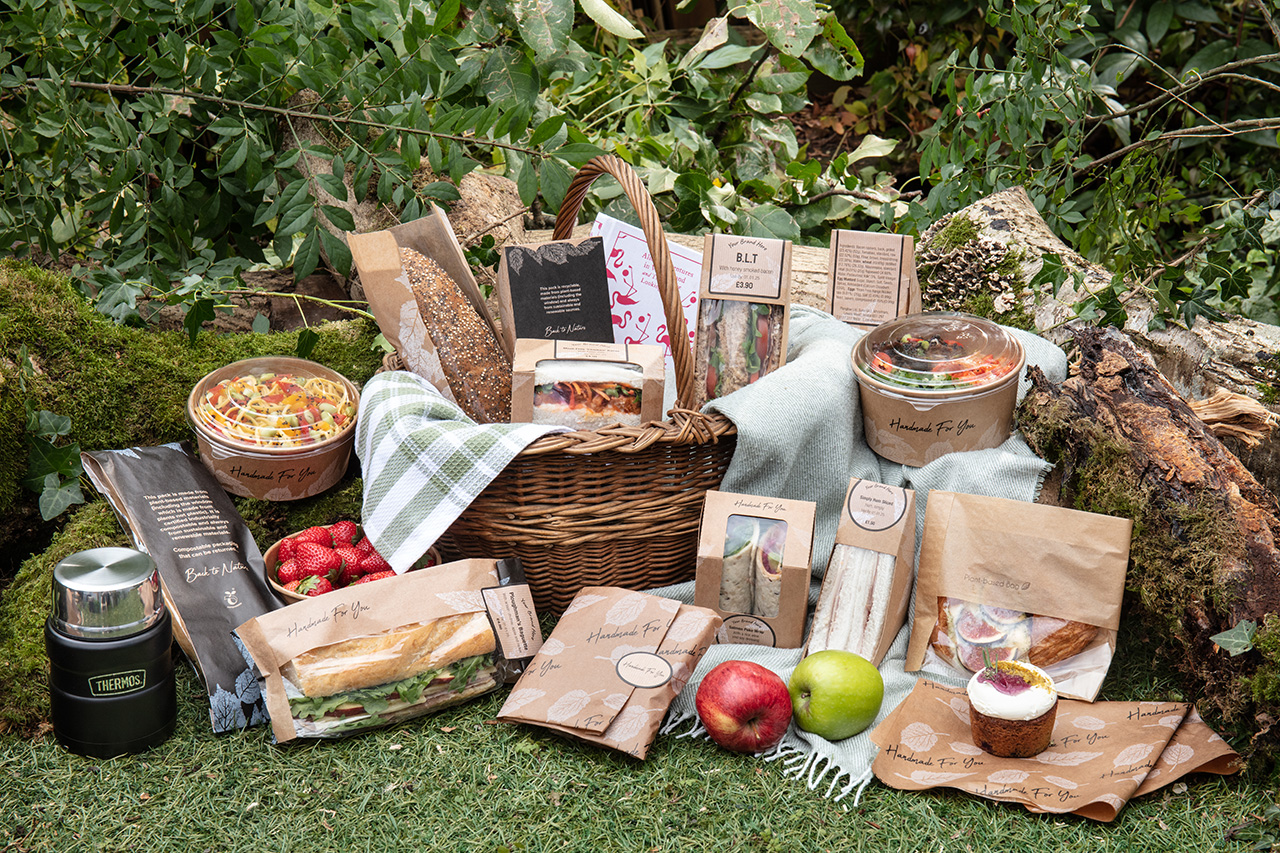
Primary considerations are the food(s) it’s going to hold, shelf life required, then how and where they anticipate this being eaten by the consumer. It’s great to have something that looks the part but if not fit for purpose, this will cause issues. Once you’ve determined the best product packaging, we recommend researching options that fit with your chosen disposal method – recyclable or compostable – and materials (paper-based, plastic, other), requesting samples to see if they are up to the task. In terms of verifying eco credentials, food providers can check these with the supplier who should be clearly identifying and qualifying any claims of sustainability. We would also recommend requesting any relevant certification. Their packaging should carry the credentials of the certification scheme and logos should always have a unique number, so waste contractors and customers can easily identify them. Operators will find recyclable and compostable categories at our online shop (planglow.com/shop), clearly showing that our products are recyclable (to OPRL standards) and/or compostable (either home compostable to NF T51-800:2015 and/or industrially compostable to EN 13432 standards).
How are consumer expectations changing around sustainability?
They are more informed than ever before. This said, subsequent financial uncertainty has set the industry back in a lot of areas, especially initiatives. Not least because cost remains the top consideration for most food and drink operators.
There’s been a marked shift in accountability and transparency, with the industry taking significant steps to stamp out greenwashing. Planglow has not always got things right. We had products where the materials were certified, but because the item as a whole had not been tested, we stopped saying they were suitable for that specific disposal route. We now offer a comprehensive range of certified products and are continuously expanding this selection. As a small business, this has represented a significant investment – both financially and in terms of time. It has taken over a year to complete the certification process for our latest range, and this is in addition to initial testing and development. It’s disappointing that some businesses, often much larger than us, are still using terms like ‘biodegradable’ and not being clear about which of their products hold certification.
How do you compete in such a competitive marketplace?
We try to stay ahead of developing food and design trends, as well as industry developments – especially in terms of materials and disposal. Cost is another major factor, with it being such a major pinch point for customers. We use all of this to help us make informed choices about both future products, alongside honing our existing range. We’re not the biggest packaging or labelling provider but we genuinely care about our customers – and I think that comes across in what we do.
Take us through your 2025… and what’s exciting for 2026?
Well, 2026 is actually our 40th year, which is a huge milestone and makes us one the longest-running labelling and packaging providers on the market. A lot has been going on behind the scenes to make us the most cost-effective and robust out there, and this year our customers may start to notice it becoming more evident. We have a comprehensive range of certified products that we will continue to expand and we’re proud to say these cover recyclable and compostable routes for disposal, giving food providers more options for packaging post-use. We’re also offering waste collection services through a third-party, in addition to our partnership with PRM for on-site bio processing. Our app, LabelLogic Live, is constantly evolving and we will be delivering new features throughout the year.
Who do you work with and who would you like to work with in the future?
In terms of our labelling software, LabelLogic Live, we work with many leading third-party recipe management providers – including Access, CaterCloud, Caternet, CIVICA, Erudus, Fourth, IndiCater, Kafoodle, My Purchasing Partner and Pelican – meaning our software integrates with theirs to offer seamless data management across both platforms. Through our integration with Erudus, we also offer access to 42,000 branded products from 800 manufacturers and 140 regional and national wholesalers.
And we have long-running partnerships with Kelgray for roll printers and Soken for heat seal machines.
On the disposal-side, we’ve teamed up with bioprocessing experts, PRM Waste Systems, for an easy, ecological and cost-effective method for disposing of food and packaging waste onsite. This uses their brilliant units to break down food and plant-based packaging into a soil enricher, which can then be used to grow more crops or produce a supplementary biomass fuel.
We have partnered with Zap Waste Systems to help customers access commercial composting collections across the UK. Whether you’re a café, caterer or foodservice provider, this connects you with local waste providers who collect compostable packaging and deliver it to certified composting facilities.
Given the current low uptake for composting services, we feel the best way forward is for packaging providers to team up on collections, driving higher volumes and helping to grow the infrastructure for everyone. With this in mind, we are keen to hear from others who want to do this, as well as establishing partnerships with software businesses – basically, drop us a line if you think we can work together!
ALL ABOUT THE DETAIL
Campbell’s Kitchen operates out of Whitefriars Business Centre – a landmark building in Bristol’s CBD. It provides popular catering and café services to residents and beyond, launching two food trucks in 2025. The corporate side averages around 1000 covers per week and the café has a footfall of several hundred per day.
Owner and founder Paul Campbell launched in 2011. Originally called A Fair Shot, as the name suggests he seeks to offer fair wages and an environment in which his team are given the space to develop their craft and passion for food.
A Fair Shot started out in Brislington, south-east Bristol, moving to Whitefriars in 2014, rebranding as Campbell’s Kitchen in 2018. “Setting up the business was an itch I wanted to scratch,” said Campbell. “I had two kids at the time, so finishing at 2.30pm was ideal. Then I kept having kids and I’ve continued to be able to spend time with all of them.”
His team are a mix of front and back of house staff, with some working across both. Regardless of their role, everyone is encouraged to put forward ideas: “They are all passionate about food. None are chefs but all of them really love cooking. I allow people space to try things that might not always work, as long as they learn from it.”
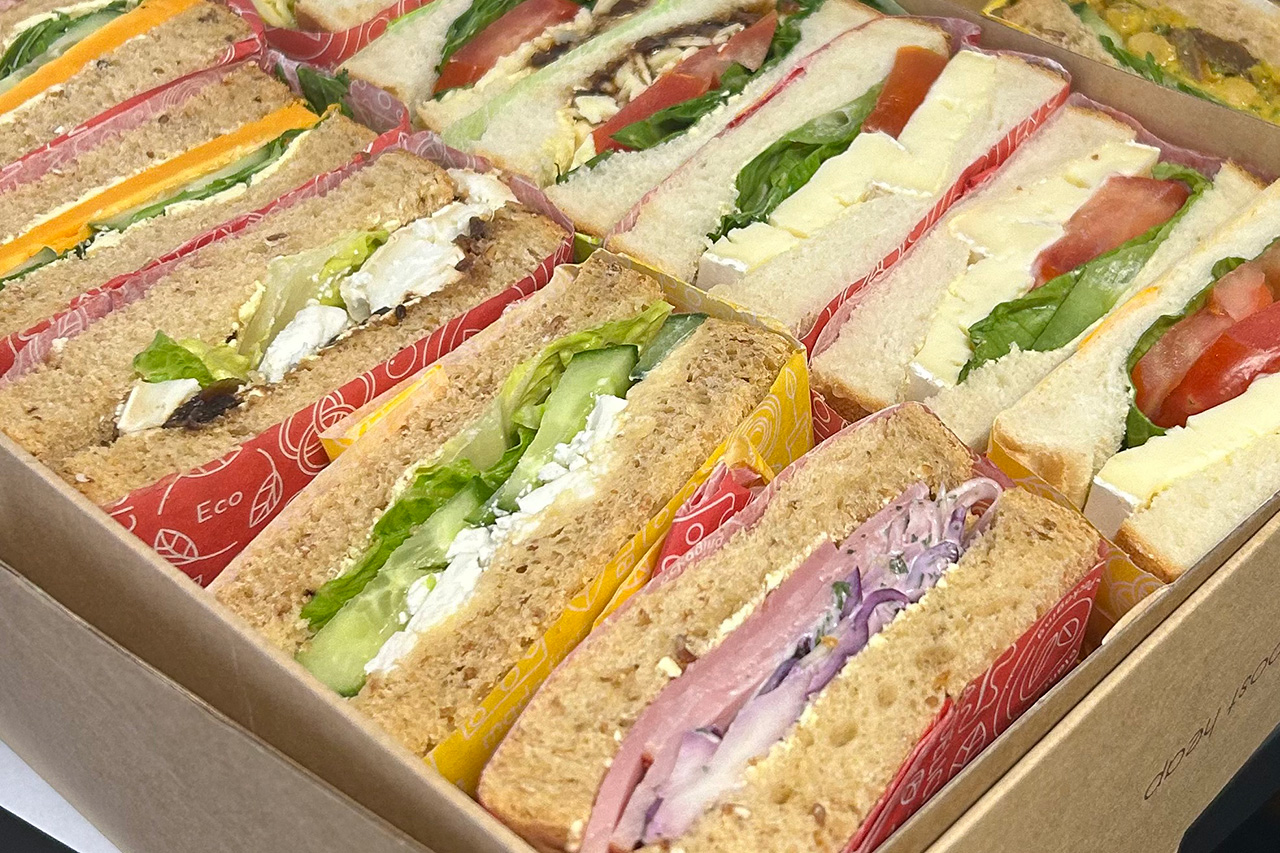
Campbell went into catering at 17, initially because it was fast-paced and fun. “The industry has a lot of energy. Then, as I’ve progressed, it’s the attention to detail that appeals most. So, if we’re sending out a large catering box of sandwiches, I’ll think about the layout, the different types of bread, the fillings – and how they can all sit together, which is something our customers notice and appreciate,” he explained. “I’ll make sure each sandwich is individually wrapped in a different colour paper, that way the customer gets a better experience.”
His paper of choice is from Planglow’s Botanical Plus range – versatile and grease-resistant, coming in three shades, adding a pop of colour to Campbell’s in-café display of baked treats. He was an early adopter of Planglow’s new Back to Nature branded collection, utilising compostable and recyclable pots for daily specials. Meanwhile, sandwich bags, labelling, and recyclable and industrially compostable bloomer packs are used in the food trucks.
“Planglow’s products are certainly a selling point when it comes to engaging new corporate clients, as we’re able to say our packaging is compostable, making it easier to convert an enquiry into a sale.
“We started out with plastic trays, as in 2011 that was the accepted norm, but weren't happy from an ethical standpoint or in terms of visual impact. We got a load of products in and Planglow’s were the best – both in terms of holding the volume of food and overall presentation. We’ve tried see-through lids from another company but they’re just not sturdy, and you can’t stack on top of each other. With Planglow, however, I know that if I’m catering for say 100 people, I’m confident I can stack, carrying them from the van. This makes five trips from what could otherwise be 20 back and forth.”
Campbell’s corporate catering boxes are, in many ways, the perfect demonstration of everything the company stands for: fresh, quality foods, beautifully presented. Likewise, the cafe’s signature salad bar and daily specials: “People really make use of us on the days they are in the office because they get something they know they won’t have at home.”
With a career spanning four decades, Campbell has seen many trends come and go, so how does he stay ahead? “Fresh ingredients! A lot of the time it’s not necessarily about reinventing the wheel and while certain fads come and go, for me, it’s about making sure that whatever you’re doing, you’re doing it well.”
Unsurprisingly, he describes financial instability as one of the biggest challenges. “There was a feeling of optimism which has dissipated, and businesses in general are sitting on their budgets much more in anticipation of what may not be coming. Rising costs also have a knock-on effect. When I first started out, you were told to aim for a net profit of around 30-40% – today, that’s 15-20% and you have to produce a lot of volume to compensate for that. It’s difficult, because you want to provide the best working conditions possible but are also constrained by how much you can actually charge people, so that’s always a balancing act. For me, those who take the opportunity to innovate will come out on top.”